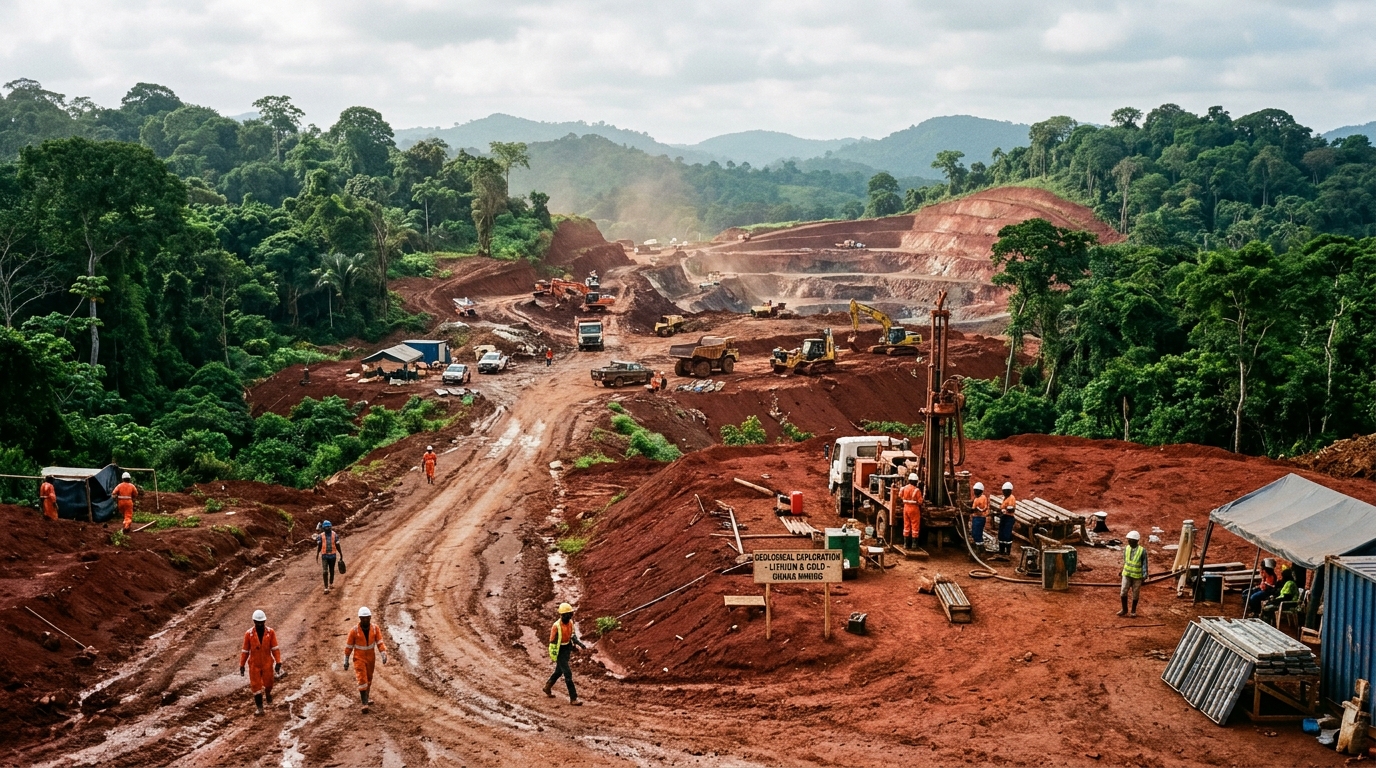
| Jurisdiction | Republic of Ghana (West Africa) |
| Target Sectors | Gold, Lithium, Manganese, Bauxite, Graphite, Nickel, Tantalum |
| Analytical Tiers | National (Macro) | Sub-National (Western & Ashanti Corridors) | Asset Level |
| Time Horizons | Short Term (0–2 years) | Medium Term (2–5 years) | Long Term (5+ years) |
| Methodology | Six External Risk Dimensions Framework with Leading Indicators Mapping |
Context & Analytical Scope
Ghana has long stood as one of Africa's leading gold producers and is now actively developing a diversified critical-minerals base, encompassing significant deposits of lithium, manganese, and bauxite.
This independent assessment examines where the substantive risks lie for existing gold operations and greenfield critical mineral assets, how those risks interact, and why risk is concentrated in specific dimensions rather than evenly distributed across the sovereign territory.
Core Findings from the Assessment
Ghana is emerging as a moderate-risk, comparatively attractive jurisdiction
For gold and emerging critical minerals, Ghana stands out favorably in West Africa. Its democratic institutional history and rule of law offer a sound basis for entry, investment, and operational decisions, subject to specific concentrated points below.
Risk is concentrated, not spread evenly
A small number of dimensions carry most of the exposure. While institutional stability and sovereign rule of law remain resilient, environmental and community friction around water and local beneficiation expectations require intensive management.
One local issue carries risk across several dimensions
A single, locally rooted issue—illegal artisanal mining (locally referred to as galamsey)—transmits risk across multiple dimensions: river water turbidity, fenceline community grievances, environmental regulatory scrutiny, and political election rhetoric.
Resource nationalism needs a more careful reading
The drivers of resource nationalism and the direction of mining policy in Accra are less arbitrary than global headlines suggest. Calls for domestic lithium processing and state participation reflect structured parliamentary debate rather than uncompensated asset seizure.
Security exposure is regional, not national
Security concerns are geographically bounded to northern border regions adjoining the Sahel and localized chieftaincy disputes, leaving the southern and western extractive corridors and port links stable.
The outlook depends on reform delivery
Much rests on whether announced regulatory updates for green minerals and planned infrastructure investments—particularly the Western Rail Line modernization to Takoradi Port—are carried through in practice.
Dimensions of the Ghana Operating Environment
Political & Macroeconomic
Ghana’s political environment is defined by competitive, regular democratic transfers of power between the New Patriotic Party (NPP) and the National Democratic Congress (NDC). Public debt restructuring under the IMF Extended Credit Facility anchors macroeconomic fiscal targets.
Security & Conflict
National security forces maintain firm control over the primary mining districts in the Ashanti and Western regions. Security concerns in mineral areas do not stem from armed insurgency, but rather from local friction between formal concessions and artisanal mining collectives.
Regulatory & Fiscal
Ghana’s Minerals and Mining Act provides a mature legal framework, though emerging minerals such as lithium are subject to new policy frameworks emphasizing higher royalty tiers and state equity participation. Stabilization clauses remain enforceable under Ghanaian law.
Infrastructure & Logistics
The Port of Takoradi serves as the primary export gateway for manganese, bauxite, and future lithium concentrate. While port handling throughput has expanded, inland rail rehabilitation requires continuous monitoring to relieve congested highway routes.
Water & Energy Access
Hydropower generation from Akosombo and thermal gas generation from the Western Basin provide the industrial grid base. However, heavy seasonal rains and high water turbidity from unregulated artisanal mining place stress on industrial water intake facilities.
Social Licence to Operate & Community
Traditional authorities (Paramount Chiefs) hold constitutional and customary significance in land tenure. Successful operations require clear, direct community development agreements (CDAs) and transparent local hiring quotas.
Full Evaluation Access
This public summary outlines the high-level methodology and findings of our Ghana evaluation. The complete, confidential client report includes:
- Asset-level quantitative risk ratings across 6 dimensions
- Leading indicators tracking matrix with trigger thresholds
- Detailed sub-national escalation pathways for transport corridors
- Confidential mitigation recommendations for operator posture